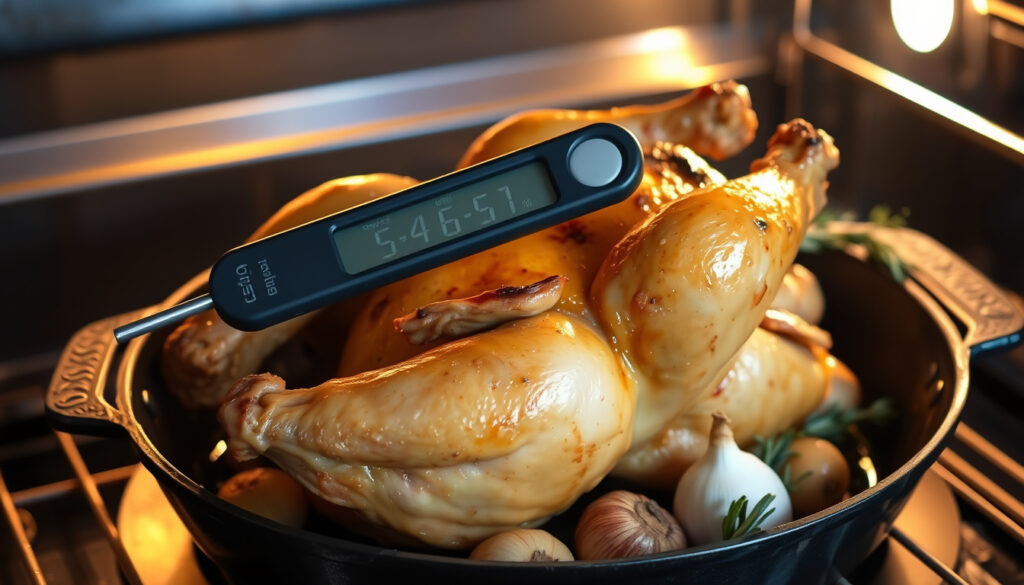
How to Roast a Chicken: Temperature, Time & Tips
Anyone who’s pulled a dry, pale bird out of the oven knows the frustration. Roasting a chicken seems simple, yet the gap between a perfect golden bird and a disappointing one often comes down to a few specific choices about temperature, timing, and whether to cover it. This guide settles those contradictions with precise formulas from trusted sources.
Optimal oven temperature: 190°C–220°C (375°F–425°F) depending on method ·
Cooking time per 500 g (1 lb): 20 minutes at 180°C/350°F ·
Safe internal temperature: 75°C (165°F) measured in the thickest part of the thigh ·
Typical roast weight: 1.5–2 kg (3.3–4.4 lb) ·
Resting time before carving: 15–20 minutes
Quick snapshot
- High start: 220°C (425°F) for 10 min (Fearless Fresh (cooking blog))
- Reduce to 180°C (350°F) for remainder (RecipeTin Eats (recipe developer))
- Internal finish: 75°C (165°F) (Knorr (food brand)) (Fearless Fresh (cooking blog))
- 1.5 kg: 1 hr 20 min at 190°C (BBC Good Food (UK recipe authority))
- 2 kg: 1 hr 40 min at 180°C (PERDUE (poultry producer))
- Formula: 20 min per 500 g (RecipeTin Eats (recipe developer)) (BBC Good Food (UK recipe authority))
- Uncovered: crispy skin (Knorr (food brand)) (A Fork and a Pencil (home cooking blog))
- Covered: moist meat but soft skin (A Fork and a Pencil (home cooking blog))
- Cover only if browning too fast (Allrecipes (recipe platform))
- Not drying the skin (BBC Good Food (UK recipe authority)) (Epicurious (food magazine))
- Skipping rest (Knorr (food brand)) (Epicurious (food magazine))
- Undersalting (Epicurious (food magazine))
- Using low heat only (Epicurious (food magazine)) (Epicurious (food magazine))
These key specifications form the foundation of a successful roast.
| Parameter | Recommended Value | Why It Matters |
|---|---|---|
| Ideal oven temperature | 190°C–220°C (375°F–425°F) | Higher heat crisps skin; lower heat dries without browning (BBC Good Food (UK recipe authority)) |
| Cooking time per 500 g | 20 min at 180°C/350°F | Consistent formula across sources (RecipeTin Eats (recipe developer)) |
| Safe doneness | 75°C (165°F) in thigh | USDA standard for food safety (Knorr (food brand)) |
| Rest time | 15–20 min | Allows juices to redistribute (Knorr (food brand)) |
| Weight of typical chicken | 1.5–2 kg (3.3–4.4 lb) | Most common size for home ovens (PERDUE (poultry producer)) |
| Brining benefit | 3–6% salt solution | Increases moisture retention (Serious Eats (food science resource)) |
The home cook faces a hard choice: uncovered roasting delivers crackling skin but demands precise timing to avoid dry breast meat. Covering the bird traps steam, guaranteeing moisture but sacrificing the golden finish that makes a roast chicken memorable.
What is the best way to roast a chicken?
- Preheat oven to 425°F (220°C) for crispy skin.
- Pat chicken dry with paper towels and season generously.
- Start at high heat: 10 minutes at 220°C (425°F).
- Reduce oven to 350°F (180°C) and roast for 20 minutes per 500 g.
- Check internal temperature: 165°F (75°C) in the thickest part of the thigh.
- Rest 15–20 minutes under loose foil before carving.
Preheat to 425°F (220°C) for crispy skin
- Starting the oven at 220°C (425°F) initiates browning quickly. Fearless Fresh (cooking blog) notes that a 4-pound chicken at 400°F takes about 1 to 1.5 hours, but a hotter start shortens the window for crisping.
- BBC Good Food (UK recipe authority) cautions that damp skin prevents crisping, so pat the bird dry with paper towels before oiling and seasoning.
Starting high heat then lowering to 350°F (180°C)
- RecipeTin Eats (recipe developer) advocates a two-stage approach: 10 minutes at 220°C (450°F) then reduce to 180°C (350°F) for 20 minutes per 500 g.
- PERDUE (poultry producer) suggests lowering from 400°F to 350°F before adding the chicken, a gentler start that still builds color over a longer roast.
- This method balances Maillard reaction on the skin with even cooking through the meat.
Essential steps: season, truss, and rest
- Season generously — under the skin and inside the cavity — at least 1 hour before roasting. America’s Test Kitchen (cooking show) recommends salting and refrigerating uncovered for 12–24 hours to dry the skin and deepen seasoning.
- Trussing isn’t mandatory but keeps legs and wings from overcooking. Jamie Oliver (celebrity chef) ties legs with string but leaves wings loose for even browning.
- Rest the chicken 15–20 minutes under loose foil after roasting. Knorr (food brand) states this step is non-negotiable for juicy meat.
Should I cover my chicken with foil when roasting?
When to cover: preventing over-browning or drying
- Covering the chicken with foil traps steam, which softens the skin but keeps breast meat from drying out if your oven runs hot. A Fork and a Pencil (home cooking blog) uses a covered method at 140°C (285°F) for 3 hours, then finishes uncovered at 190°C (375°F) for 40 minutes.
- The trade-off: Knorr (food brand) recommends starting covered and uncovering halfway to get a moister result, but the skin won’t get as crispy as an uncovered roast.
When to leave uncovered: for crispy skin
- Knorr (food brand) states clearly: roasting uncovered helps the skin become crispy and golden brown. If crispiness is the priority, leave the bird exposed the entire cook.
- Allrecipes (recipe platform) suggests covering only if the top is browning too quickly, then removing the foil for the final 15 minutes.
- Gordon Ramsay (celebrity chef) and Jamie Oliver (celebrity chef) do not cover during the initial roast, relying on butter under the skin and high heat for browning.
Covering during resting period
- All sources agree: tent the chicken loosely with foil during the 15–20 minute rest. Knorr (food brand) says this traps heat without creating a steam bath, allowing carryover cooking while the skin stays reasonably crisp.
Covering the entire roast guarantees a moist bird—but at the cost of the crackling skin that defines a great roast chicken. Uncovered roasting delivers better texture but demands a meat thermometer to avoid dry breast meat. The compromise: start uncovered, then tent with foil if the skin threatens to burn.
The takeaway: choose your priority and adjust the method accordingly.
How long does it take to roast a whole chicken?
Cooking time based on weight: 20 min per 500 g at 180°C/350°F
- The most reliable formula across sources: 20 minutes per 500 g (1.1 lb) at 180°C (350°F). RecipeTin Eats (recipe developer) adds 10 minutes at 220°C for initial crisping, then the 20 min/500 g count starts after reducing the heat.
- PERDUE (poultry producer) publishes a different guideline: 25 minutes per pound (about 55 minutes per kg), which is more conservative. For a 2 kg chicken, that means roughly 1 hour 50 minutes at 350°F.
- BBC Good Food (UK recipe authority) recommends 1 hour 20 minutes for a 1.5 kg bird at 190°C, aligning closely with the 20 min/500 g rule.
Four weights, four times — all using the same formula:
| Chicken Weight | Cooking Time (min at 180°C) | Total Time with High Start |
|---|---|---|
| 1.2 kg (2.6 lb) | 48 min | ~58 min |
| 1.5 kg (3.3 lb) | 60 min | ~1 hr 10 min |
| 1.8 kg (4.0 lb) | 72 min | ~1 hr 22 min |
| 2.0 kg (4.4 lb) | 80 min | ~1 hr 30 min |
These timing guidelines ensure consistent results when combined with a meat thermometer.
Temperature check: 75°C/165°F in the thigh
- The USDA standard for poultry is 165°F (75°C). Knorr (food brand) advises checking the thickest part of the breast and the innermost part of the thigh and wing with a meat thermometer.
- Fearless Fresh (cooking blog) suggests pulling the bird at 150°F (66°C) and resting covered for 15 minutes, during which carryover cooking brings it to about 160°F (71°C). This is a more advanced technique that risks undercooking if not carefully monitored.
- A chef demonstration (YouTube) targets 155°F in the breast followed by a 10–12 minute rest, relying on carryover to hit safe temperatures.
Resting time: 15–20 minutes
- Knorr (food brand) is explicit: a minimum 15-minute rest is required before carving.
- Skipping the rest releases juices onto the cutting board, leaving the meat dry. The resting period allows the protein fibers to reabsorb moisture.
How do I roast a chicken without drying it out?
Brine or dry brine for moisture retention
- Serious Eats (food science resource) demonstrates that brining increases moisture retention by denaturing proteins and allowing cells to absorb extra water. A 3–6% salt solution is typical, though the optimal percentage varies among recipes.
- America’s Test Kitchen (cooking show) recommends dry-brining: salting the chicken and refrigerating uncovered for at least 12, ideally 24 hours. This dries the skin for better browning while the salt penetrates the meat.
Basting and butter under the skin
- Sliding softened butter mixed with herbs under the breast skin adds fat and flavor directly to the meat. Epicurious (food magazine) calls this the single best trick for moist breast meat.
- Basting every 20–30 minutes with pan drippings adds moisture to the surface, though BBC Good Food (UK recipe authority) notes that frequent opening of the oven door drops the temperature, extending cook time.
Using a meat thermometer for precise doneness
- Overcooking is the primary cause of dry chicken. Reddit r/Cooking (cooking community) threads consistently attribute dry results to cooking beyond 165°F (75°C).
- A probe thermometer inserted into the thickest part of the breast (not touching bone) gives real-time temperature. Pull the bird at 155°F–165°F depending on whether you plan to rest with carryover cooking.
Mastering moisture comes down to brining, fat addition, and precision cooking.
What are common mistakes when roasting chicken?
Not drying the skin before seasoning
- BBC Good Food (UK recipe authority) calls this the most frequent error: moisture on the skin turns to steam in the oven, preventing crisping. Pat the bird dry with paper towels and refrigerate uncovered if possible.
Skipping the resting period
- Cutting into a chicken straight from the oven releases its juices. Knorr (food brand) states that resting for at least 15 minutes allows the meat to reabsorb those juices, making every slice moist.
Cooking at too low or uneven temperature
- Epicurious (food magazine) warns that an oven below 175°C (350°F) produces tough, leathery skin because the meat cooks before the surface can brown. Stick to at least 180°C and use an oven thermometer to verify accuracy.
Upsides
- Uncovered roasting yields crisp, golden skin (Knorr, Allrecipes)
- High-start method develops deep Maillard browning (RecipeTin Eats)
- Resting improves juiciness across all methods (multiple sources)
- Butter under skin adds moisture without covering (Epicurious)
- Dry-brining boosts both moisture and flavor (America’s Test Kitchen)
Downsides
- Covering during entire roast softens skin permanently (Knorr, A Fork and a Pencil)
- Low temperature (below 175°C/350°F) creates tough skin (Epicurious)
- Skipping rest dries out meat even if perfectly cooked (Knorr)
- Undersalting leaves meat bland (Epicurious, America’s Test Kitchen)
- Overcooking past 165°F dries breast meat (Reddit r/Cooking, USDA)
“For a crisp, golden bird, roast uncovered the whole time. For a moister result, start covered and uncover halfway.”
Knorr (food brand), Roasting Guide
“A 4-pound chicken at 400°F takes about 1 to 1.5 hours. Pull it at 150°F and let carryover do the rest.”
Fearless Fresh (cooking blog), Roast Chicken Timing
“400°F is the sweet spot for roasting whole birds — it browns well and limits smoke.”
America’s Test Kitchen (cooking show), Roast Chicken Method
“The best trick for moist breast meat: slide butter under the skin before roasting.”
Epicurious (food magazine), How to Roast a Chicken
The pattern across every source is consistent: dry skin, adequate salt, a meat thermometer, and a proper rest separate a great roast chicken from a mediocre one. The choice to cover or not is the sole remaining trade-off. For the home cook who wants both moist meat and crispy skin, the evidence points to starting uncovered at high heat, then tenting with foil only if browning accelerates too quickly. For the cook who prioritizes moisture above all, a covered roast with a final uncovered blast delivers reliable results.
The evidence consistently supports these best practices.
Related coverage: How to Roast a Chicken – Crispy Skin and Juicy Meat fördjupar bilden av How to Roast a Chicken – Crispy Skin and Juicy Meat.
Frequently asked questions
Can I roast a chicken without trussing it?
Yes. Trussing keeps legs and wings from drying out but is not essential. Jamie Oliver (celebrity chef) ties legs but leaves wings loose. If you skip trussing, tuck the wing tips under the bird and check leg temperature for doneness.
Should I rinse the chicken before roasting?
No. Rinsing raw chicken can spread bacteria around the kitchen. USDA (food safety regulator) advises against washing poultry. Pat the skin dry with paper towels instead.
What herbs go best with roast chicken?
Thyme, rosemary, and sage are classic. BBC Good Food (UK recipe authority) puts thyme and garlic in the cavity. Tarragon and lemon are also popular combinations.
Can I use a convection oven?
Yes. Reduce the temperature by 20°C (25°F) from the recipe. Convection circulates hot air more efficiently, so check for doneness 10–15 minutes early. ThermoWorks (kitchen thermometer brand) recommends using a probe to track temperature accurately.
How do I make gravy from the pan drippings?
After removing the chicken, place the roasting pan on the stovetop over medium heat. Add 2 tablespoons of flour to the drippings and whisk for 1 minute, then slowly pour in 2 cups of chicken stock while whisking. Simmer until thickened. BBC Good Food (UK recipe authority) has a full recipe with exact measurements.
How long can I store leftover roast chicken?
Refrigerate within 2 hours of cooking. Leftovers keep for 3–4 days in an airtight container. The USDA (food safety regulator) advises reheating to 165°F before eating.
Can I roast a frozen chicken?
Not safely in most home ovens. The USDA warns that cooking a frozen chicken can result in uneven cooking, with the outside done while the inside remains undercooked. Thaw completely in the refrigerator (24 hours per 2 kg) before roasting.
More related posts
 Ginny and Georgia Season 4: Confirmed Release, Cast & Updates
 Chuck Norris Dies at 86: His Life and Legacy
 Shamele (Briti h TV Serie ): Ca t, Sea on & Key Fact
 Animal Friends Pet Insurance: Reviews, Payouts & Coverage
 Race Across the World Experience: London Guide & Reviews
 Rixos Sharm El Sheikh: Which Resort Is Best for You
 Mission Impossible Films in Order: Complete Chronological Guide