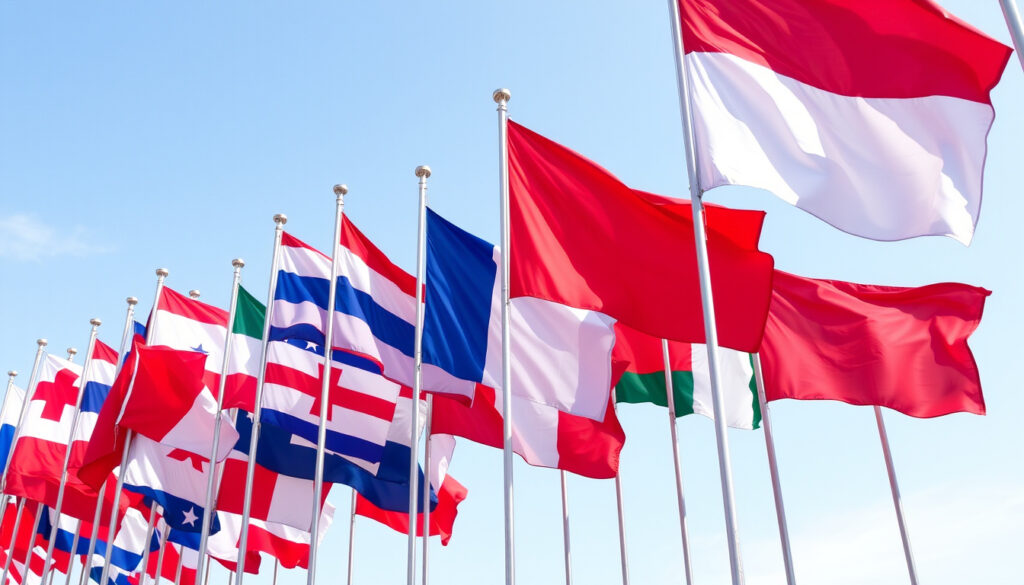
Red White and Blue Flags: How Many Countries Use These Colors?
Red, white, and blue dominate national flags worldwide, yet their ubiquity creates a recognition challenge. The United States flag, with its 13 stripes and 50 stars (National Archives), is one of the most recognizable examples. From the United Kingdom’s Union Jack to France’s tricolor, these three colors tell stories of revolution, independence, and national identity.
Countries with red-white-blue flags: 29+ · Most common pattern: Horizontal tricolor · Continent with most: Europe · Oldest still in use: French tricolor (1794)
Quick snapshot
- The U.S. flag has 13 stripes and 50 stars (National Archives)
- France adopted its vertical tricolor in 1794 (Government of France)
- The Union Jack combines three crosses (The Royal Family)
- Exact count varies with inclusion of non-sovereign territories
- Shade variations (maroon, navy) blur the tally
- 1794: French tricolor adopted (Government of France)
- 1777: U.S. flag first standardized (National Archives)
- 1801: Union Jack formalized (The Royal Family)
- Expect continued use in new nations symbolizing liberty
- Digital flag emoji standards may add variations
Here is a summary of key data about red-white-blue flags.
| Fact | Value |
|---|---|
| Total UN member states with red-white-blue flags | Approximately 30 |
| Flags with horizontal stripes | Majority (e.g., Russia, Netherlands, Serbia) |
| Flags with vertical stripes | Several (e.g., France) |
| Flags with stars | Common (US, Liberia, Chile, Cuba) |
How many countries have red, white and blue flags?
Total count of countries with red-white-blue flags
According to the World Population Review, more than 50 countries and territories use red, white, and blue in their national flags (World Population Review (demographic data compendium)). However, if you count only sovereign states recognized by the United Nations, the number is around 30. The precise count depends on how you define the shades—some nations use maroon or navy, which can make classification tricky.
Breakdown by continent
Europe has the highest concentration, with at least 12 countries. In the Americas, nations like the United States, Chile, and Cuba fly red-white-blue. Africa has fewer: Liberia, South Africa (red-white-blue form part of its Y-shaped design). Asia adds Laos, Taiwan, and Russia (transcontinental). Oceania includes Australia, New Zealand, and Fiji.
Most common design patterns
The horizontal tricolor is the dominant pattern, used by Russia, Serbia, Slovenia, and the Netherlands. Vertical tricolors appear in France and some former French colonies. The U.S. flag is unique: a canton with stars on a field of stripes.
With more than 50 nations sharing a color palette, the ubiquity of red-white-blue makes flag identification harder. Travelers and researchers alike must look beyond colors to stripe orientation and symbols.
The implication: color order and stripe orientation are the key differentiators for distinguishing these flags.
Which countries have a flag with red, white, and blue?
List of major countries with red-white-blue flags
- United States – 13 alternating red and white stripes, blue canton with 50 white stars (National Archives)
- France – Vertical blue, white, red tricolor (Government of France)
- United Kingdom – Union Jack, combining the crosses of St George, St Andrew, and St Patrick (UK passport redesign) (The Royal Family)
- Russia – Horizontal white, blue, red tricolor (President of Russia / Kremlin)
- Netherlands – Horizontal red, white, blue tricolor (Government of the Netherlands)
- Thailand – Five horizontal stripes red, white, blue, white, red (Ministry of Foreign Affairs of Thailand)
- Czech Republic – White over red with blue triangle at hoist (Office of the President of the Czech Republic)
- Chile – Blue canton with white star, white and red bands (Government of Chile)
Flags with coats of arms or emblems
Several countries add their national coat of arms to the tricolor. Serbia uses a horizontal red, blue, and white flag with a shield (Government of Serbia). Slovakia’s flag is white, blue, red with a double-cross coat of arms (Government Office of the Slovak Republic). Slovenia (white-blue-red) and Croatia (red-white-blue) also feature their emblems.
Flags of the United States, France, United Kingdom, and others
These three nations are the most internationally recognized. The U.S. flag is the only one that uses both stripes and a star-covered canton. France’s vertical tricolor inspired many independence movements. The Union Jack’s design—overlapping crosses—is unique to the UK (St. George’s Day). The Netherlands’ flag evolved from the orange-white-blue Prince’s Flag of the 16th century (Government of the Netherlands).
The very popularity of red-white-blue flags creates a recognition problem: a horizontal tricolor could be Russia, Serbia, or the Netherlands. Color order and shade are the only differentiators.
Which countries use blue, white, and red in their flag?
Countries with horizontal blue-white-red stripes
- Russia – white, blue, red (top to bottom)
- Serbia – red, blue, white (with coat of arms)
- Netherlands – red, white, blue (different order)
- Luxembourg – red, white, light blue (Luxembourg public portal)
Countries with vertical blue-white-red stripes
The vertical arrangement is less common. The prime example is France (blue, white, red from hoist). This pattern spread to former French colonies such as Chad (blue, yellow, red – not red-white-blue) and Belgium (black, yellow, red – different colors). Few countries other than France use the exact blue-white-red vertical tricolor.
Flags with different shade variations
Luxembourg uses a lighter blue than the Netherlands (Luxembourg public portal). Paraguay’s flag has a red-white-blue design but is unique because the obverse and reverse sides differ (Encyclopaedia Britannica (educational reference)). Thailand’s central stripe is a deeper navy than the outer blue. These nuances matter for accurate identification.
This table compares notable red-white-blue flags.
| Country | Pattern | Notable feature | Year adopted |
|---|---|---|---|
| United States | Stripes + canton | 50 stars for 50 states | 1777 (first flag act) |
| France | Vertical tricolor | Blue, white, red (hoist→fly) | 1794 |
| Russia | Horizontal tricolor | White, blue, red (top→bottom) | 1705 (restored 1991) |
| Netherlands | Horizontal tricolor | Red, white, blue (evolved from orange) | 16th century (official 1937) |
The pattern reveals a historical divide: horizontal tricolors dominate among Slavic and Germanic nations, while vertical tricolors are tied to the French Revolutionary legacy.
What are the common patterns of red, white, and blue flags?
Horizontal tricolor flags
These are the most frequent. Slavic countries often use white, blue, and red (or red, blue, white)—the Pan-Slavic colors. Russia, Serbia, Slovenia, Croatia, Slovakia follow this pattern. The Netherlands uses red, white, blue but in a different order. Thailand uses five stripes: red, white, blue, white, red.
Vertical tricolor flags
France is the prototype. Its blue-white-red vertical bands have been emulated by nations such as Ireland (green, white, orange—different colors) and Italy (green, white, red). The vertical arrangement is less common in red-white-blue combinations.
Flags with stars or other symbols
Stars appear on the flags of the United States (50 white stars on blue), Chile (single white star on blue canton), Liberia (single white star), and Cuba (single white star on red triangle). The blue triangle on the Czech flag also contains no star but stands out. Paraguay’s obverse features the national coat of arms, the reverse the treasury seal.
If you see a flag with red-white-blue stripes arranged horizontally, it is likely a Slavic or Dutch-influenced design. Vertical stripes almost always point to France or a former French territory.
The pattern: horizontal tricolors are overwhelmingly dominant, especially in Europe.
What is the historical origin of red, white, and blue flags?
The French Revolution and the tricolor
The French tricolor was adopted on 15 February 1794 (Government of France). The colors are popularly interpreted as standing for liberty, equality, and fraternity, though the official government notes that this meaning became attached after the flag was already in use (Government of France). Regardless, the tricolor became the symbol of the new republic and a template for emerging nations.
Spread to other European countries
Napoleon’s conquests spread the tricolor concept across Europe. The Netherlands’ flag predates the French Revolution but was standardized as red-white-blue in the 19th century (Government of the Netherlands). Russia’s white-blue-red flag was introduced by Peter the Great in the late 17th century, inspired by the Dutch flag (President of Russia / Kremlin).
Influence on former colonies
Many countries that gained independence in the 19th and 20th centuries adopted the red-white-blue palette to symbolize their break from colonial rule. The United States (1777), Chile (1812), and Liberia (1847) are early examples. Thailand, never colonized, adopted the Trairanga in 1917 to express national unity (Ministry of Foreign Affairs of Thailand).
Symbolism and modern variations
The meaning of the colors varies: in many flags, red stands for courage or bloodshed, white for peace or purity, and blue for justice or vigilance. France’s color meaning is tied to the Republic’s ideals. The U.S. flag’s blue canton represents vigilance, perseverance, and justice (National Archives).
“The colors of the French flag are often linked to liberty, equality, and fraternity in popular interpretation.”
Government of France (Government of France)
“The Union Flag is commonly called the Union Jack. It combines the crosses of St George, St Andrew, and St Patrick.”
The Royal Family (The Royal Family)
The historical arc shows that the French Revolution provided the template, but older flags like the Dutch and Russian predate it.
What’s known — and what remains unclear
Confirmed facts
- The French flag was first used in 1794 (Government of France)
- The US flag has 13 stripes and 50 stars (National Archives)
- The Union Jack combines red, white, and blue crosses (The Royal Family)
- The Dutch flag evolved from an orange-white-blue Prince’s Flag (Government of the Netherlands)
What remains unclear
- Exact number of countries with red-white-blue flags depends on inclusion of non‑sovereign territories and variations in shade (e.g., maroon, navy)
- The official meaning of the French flag’s colors is not definitively the revolutionary triad; the government notes it is a popular interpretation
For travelers, flag enthusiasts, and citizens of these nations, the choice is clear: pay attention to the arrangement and shade—because red, white, and blue alone won’t always tell you which country you’re looking at.
americanflags.com, worldpopulationreview.com, flaglog.com, en.wikipedia.org, face.meei.harvard.edu
For comparison, Italy’s distinctive green, white, and red tricolor shows how another European nation uses a similar three-band vertical layout with a different color palette.
Frequently asked questions
What is the flag of Russia?
The flag of Russia is a horizontal tricolor of white, blue, and red, adopted by Peter the Great and restored in 1991 (President of Russia / Kremlin).
Which country has a red-white-blue flag with a coat of arms?
Several countries do, including Serbia, Slovakia, Slovenia, and Croatia. Each places the national coat of arms on a horizontal tricolor (Government of Serbia; Government of Slovakia).
Does the flag of India have red, white, and blue?
No. India’s flag is saffron, white, and green with a blue Ashoka Chakra. It does not use red (Encyclopaedia Britannica).
What are the colors of the flag of Chile?
Chile’s flag has a blue canton with a white star, a white horizontal band, and a red horizontal band below (Government of Chile).
How many stripes are on the US flag?
There are 13 alternating red and white stripes, representing the thirteen original colonies (National Archives).
What does the blue stripe on the French flag represent?
The blue stripe is one of three vertical bands (blue, white, red). The colors are widely associated with liberty, equality, and fraternity, though the official government notes that this interpretation is not the original symbolism (Government of France).
More related posts
 Madrid Tennis Open 2025: Results, Winner, Schedule
 Little Red Riding Hood – Origins, Morals and Evolution
 Ryan Eggold Biography: Career, Personal Life, and Facts
 Racing Post Racecards Tomorrow – Complete Guide
 Jordan Banjo: What He’s Doing Now, Family, Diversity & More
 Hugo Boss Polo Shirt – Fit, Sizing and Quality Guide
 How to Roast a Chicken: Temperature, Time & Tips
 Benito Skinner: Viral Career, Relationship Status & Prime Video